Lot 169
SIR EDWARD COLEY BURNE-JONES, BT., A.R.A., R.W.S. (BIRMINGHAM 1833-1898 LONDON)
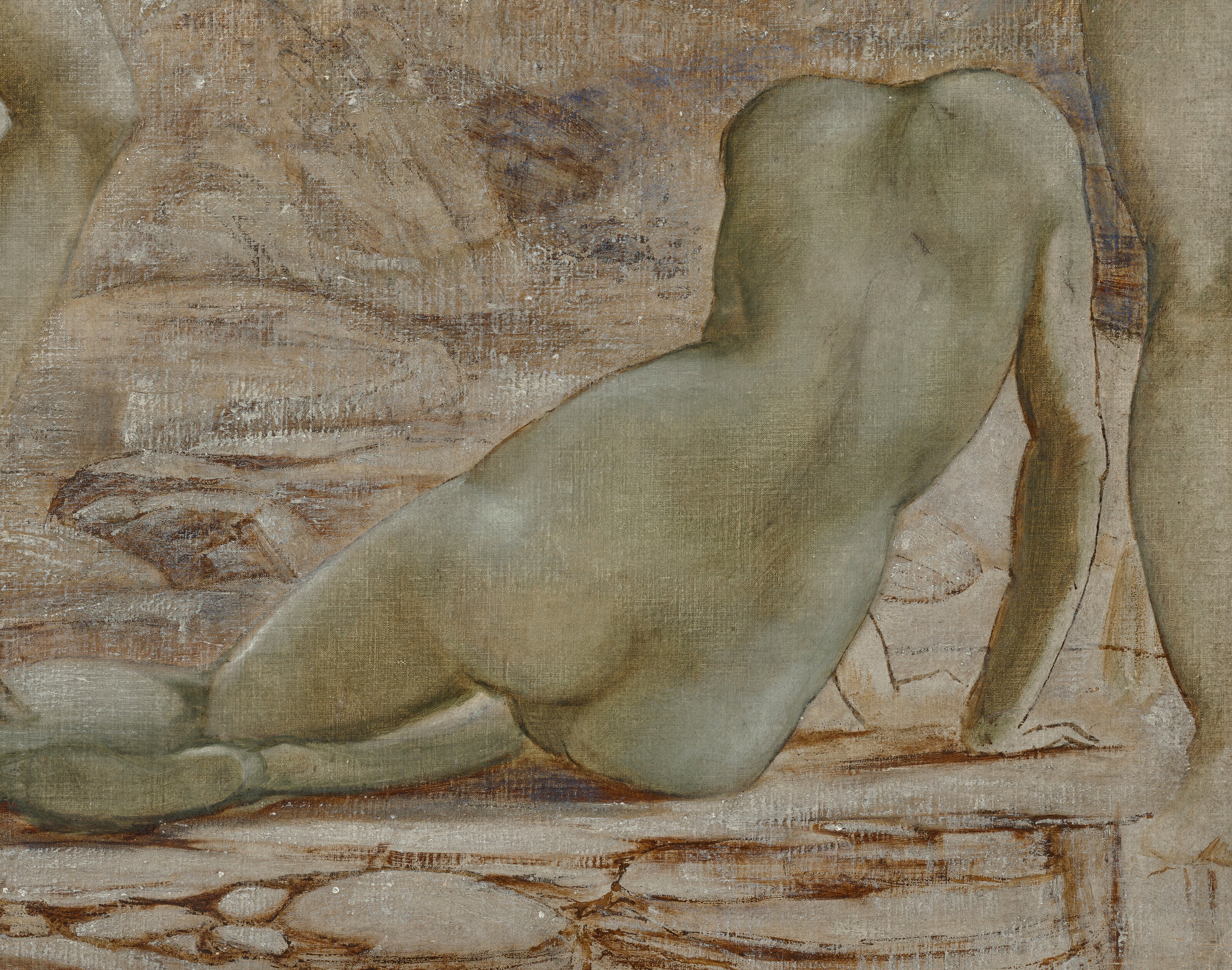
The Death of Medusa (a fragment)
Closed1 July 2026
Price Realised
GBP 40,640
More Information
Specialist note
This is a fragment of an unfinished canvas representing the death of the gorgon Medusa. One of a set of ten designs illustrating the story of Perseus's search for Medusa and his rescue of Andromeda, the series was commissioned in 1875 by the young Tory politician, and later Prime Minister, Arthur Balfour, and was conceived as a frieze running round the music room at his London house, 4 Carlton Gardens. Burne-Jones originally planned to execute some of the designs as oil paintings and others as reliefs in gilt gesso on oak panels, but when the first of these panels (National Museum of Wales, Cardiff) was exhibited in 1878 it met with a hostile reception and he decided to treat all the designs as paintings. Full-scale cartoons in gouache are in the Southampton Art Gallery, and the final oil paintings, some of them unfinished, are in the Staatsgalerie at Stuttgart.
In The Death of Medusa, which was conceived as a painting from the outset, Perseus has just cut off the gorgon's head while her two sisters, greatly distressed, circle wildly. The present fragment comes from an early version of the composition and closely relates to the cartoon, The Death of Medusa (II) (c. 1881-2, fig. 1). Both pictures show the figure of the dying Medusa, evidently inspired by the rear view of The Dying Gaul. The Dying Gaul, also known as The Dying Galatian, is an Ancient Roman marble copy of a lost Hellenistic sculpture of the late 3rd Century BC, now in the Capitoline Museums, Rome. Another fragment, A Gorgon (fig 2.), from the same canvas, was sold in these rooms on 11 July 2013, lot 47 (£217,875).
In The Death of Medusa, which was conceived as a painting from the outset, Perseus has just cut off the gorgon's head while her two sisters, greatly distressed, circle wildly. The present fragment comes from an early version of the composition and closely relates to the cartoon, The Death of Medusa (II) (c. 1881-2, fig. 1). Both pictures show the figure of the dying Medusa, evidently inspired by the rear view of The Dying Gaul. The Dying Gaul, also known as The Dying Galatian, is an Ancient Roman marble copy of a lost Hellenistic sculpture of the late 3rd Century BC, now in the Capitoline Museums, Rome. Another fragment, A Gorgon (fig 2.), from the same canvas, was sold in these rooms on 11 July 2013, lot 47 (£217,875).