|
|
|
|
|




|
|

|
|

Important paintings and sculpture from a private European collection include both light-filled landscapes and intimate interiors.
By Nicholas Maclean
|
|
|
|
|
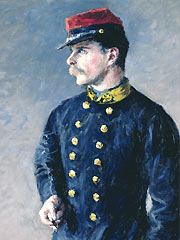
Sale 1075, Lot 5
Gustave Caillebotte
Un soldat, 1881 (detail)
Oil on canvas
Estimate: $2,500,000-3,500,000
|
|
Representative works from an important European collection form a group that embraces the Impressionist, Pointillist and Nabi moements. An unusual military portrait by Caillebotte, a lyrical seascape by Signac, a vibrant interior by Vuillard, and a bather in bronze by Degas are among the highlights. Numerous other works (including several Maillol bronzes), will be offered in the evening sale and, the following day, in the Impressionist and Modern daytime sale.
There are two idiosyncratic works by the Impressionist master Gustave Caillebotte. Le Bassin d'Argenteuil recalls the celebrated subject matter of Monet and Renoir from the early 1870s, the scene now presented with Caillebotte's characteristically vibrant purple and blue palette. The artist creates the impression of a specific moment, with additional details of aspects of river life such as the houseboats lining the opposite bank and the rigging of the boats in full sail. This detailed knowledge of rivercraft is hardly unexpected, for Caillebotte was a keen sailor and a regular participant in local regattas.
|
|
|

Caillebotte's Un soldat of circa 1881 was as unconventional a treatment of a military portrait as Edouard Manet's Le fifre fifteen years before. The soldier stands nonchalantly smoking a cigarette, likely a comment on the state of the French army in the decade after the Franco-Prussian War. With such images, Caillebotte became the most prominent painter among the Impressionists in representing characters of the Third Republic. The painting has been on loan to the Metropolitan Museum of Art in New York for the last twenty years.
The signature work from the Nabi movement within the group is Edouard Vuillard's La famille Roussel. The Nabis (the Hebrew word for Prophets) were a group of artists led by Vuillard and Pierre Bonnard who sought to emphasize the decorative nature of the picture plane. Their paintings from the 1890s focused on intimate interiors of domestic life. The richly patterned wallpapers are as important to the composition as the figures themselves. The picture's background figures - Vuillard's sister, Marie Roussel, and his mother entering the room - blend in with their surroundings. Likewise, the male figures in the foreground - one of which is Marie's new husband, the Nabi painter Ker-Xavier Roussel - are silhouetted and therefore take no precedence over any other aspect of the composition.
The collection has long been renowned for its focus on artists of the Pointillist movement. After Seurat, the group's most important member was Paul Signac. As Thadée Nathanson, the editor of the influential Arts periodical La Revue blanche and patron of the Nabi movement, wrote: 'If one were to make of what is called pointillism a kind of religion, it would claim Delacroix and the Impressionists its prophets. Seurat would be the Messiah, but Paul Signac would appear as its St Paul.' He is represented in the group by the harmonious masterwork of 1888, Portrieux. Les Mâts. Opus 182. The last part of the title refers to his method up until 1894 of numbering his paintings in the manner of musical compositions. In fact, the subject matter seems almost irrelevant, as it becomes dissolved in a play of rhythms. Even the boats take on the role of musical symbols, seeming to represent crotchets and quavers. The painting was recently included in the retrospective on the artist at the Grand Palais in Paris and at the Van Gogh Museum in Amsterdam.
The most significant sculpture to be offered in the group is Edgar Degas' Le tub. Along with La jeune fille de quatorze ans, these two works may be regarded as two of the most influential sculptures of the 19th century. The subject of the bather unaware of the viewer's presence was one that consistently reappeared in Degas' oeuvre. He frequently chose his subject matter from the Parisian demi-monde, sketching prostitutes, dancers and singers at café-concerts. His sitters accepted his presence, and were thus often oblivious to him. However, by looking down on this intimate moment of a woman bathing, we not only share the artist's viewpoint, but also become aware of her knowledge of our presence.
Degas was perhaps the first proponent of the objet trouvé, using a variety of materials and objects to create his sculpture. This would have a profound effect on artists of the 20th century, such as Picasso and Marcel Duchamp. The original sculpture from which this work was cast in bronze (National Gallery, Washington, bequest of Mr Paul Mellon), used wax to model the body, lead for the tub, plaster for the water, linen for the towel, and wood for the base. Like all Degas bronzes, they were cast in a limited edition of lettered casts shortly after the artist's death, as the originals had not been exhibited during his lifetime. The significance of this cast is that as cast 'B' (a complete set of 'A' casts is in the Metropolitan Museum of Art, New York), the three parts of body, tub and base were unusually patinated in different colours. This distinguished the different textures that are also apparent in the original, an aspect only seen in the earliest casts.
Complementing the Degas are several bronzes by the 20th-century sculptor Aristide Maillol, highlighted by Vénus (sans collier). They seek to emphasize the beauty of the female form, extending the French Rococo tradition of Boucher and Fragonard that was to be continued by Renoir on canvas and placed in the third dimension in its purest form by Maillol.
NICHOLAS MACLEAN IS CO-HEAD OF THE IMPRESSIONIST AND MODERN ArT DEPARTMENT, CHRISTIE'S NEW YORK
Back to top

|
|
|