|
|
|
|
|




|
|

|
|
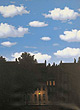

Perhaps Magritte's most famous painting, it is to be sold by the Georges and Lois de Menil Charitable Remainder Trust.
By Anika Guntrum
|
|
|
|
|
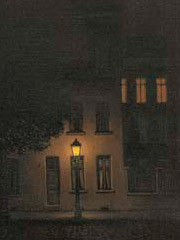
Sale 1075, Lot 36
Rene Magritte
L'empire des lumières (detail)
Oil on canvas
Painted in 1952
Estimate: $5,000,000-7,000,000
|
|
The Surrealists believed in the power of the subconscious. Considering it a repository of the dark and negative wills inherent in human nature, for them it became a source of creative activity. Creating an element of subversion that so many of the Surrealists propagated, Magritte explored his subconscious - constantly awakening and reviving dreams. Wrought with contradictions and intended to arouse wonder as it defies comprehension, L'empire des lumières succeeds in reminding the viewer of the recurring, inescapable paradoxes of life itself.
The de Menil L'empire des lumières belongs to the celebrated series of oils and gouaches based on the contrast between daylight and darkness. Magritte's concerns lay deep within our use of language and our perceptions of reality; 'I got the idea that night and day exist together, that they are one. This is reasonable, or at the very least it's in keeping with our knowledge: in the world, night always exists at the same time as day (Just as sadness always exists in some people at the same time as hapiness in others). But such ideas are not poetic. What is poetic is the visible image of the picture'. The title was suggested by one of the founders of the Surrealist movement, Paul Nougé. While the enigmatic quality of L'empire des lumières lies in its expression of the ambivalent nature of reality itself, the title was often misunderstood and mistranslated to mean 'empire' rather than 'dominion'.
|
|
|

In 1950, Dominique and Jean de Menil donated the second completed version of L'empire des lumières to The Museum of Modern Art in New York (Sylvester 723). It received great critical and public acclaim, and in 1952 the de Menils commissioned Magritte to paint the present work, the fourth completed version of this subject. Introduced by Alexander Iolas to many of the Surrealist artists, including Magritte, the de Menils assembled a vast collection of paintings, sculptures and objects. Reluctant to be labelled as 'collectors', the de Menils were actively and personally engaged with their art and fostered the development of many artists. Dominique's claim not to 'know what Surrealism is' now seems redundant, as the de Menils built one of the most renowned collections in this field over the next forty years.
ANIKA GUNTRUM IS A SPECIALIST IN THE IMPRESSIONIST AND MODERN ART DEPARTMENT, CHRISTIE'S NEW YORK
Back to top

|
|
|