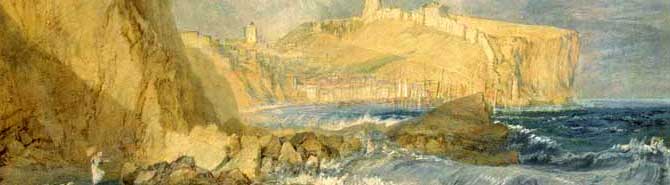
Sale 6578, Lot 59
Joseph Mallord William Turner, R.A. (1775-1851)
Scarborough, 1818
Pencil and watercolor, with scratching out
Estimate: £300,000-500,000
|
 |
Turner's "Scarborough"
By Harriet Drummond
Ruskin, Scarborough's first owner, called Turner 'The only perfect landscape painter whom the world has ever seen.'
Arguably Britain's greatest artist, Turner won admiration both as an oil painter and watercolorist. His mastery of the medium of watercolor, a combination of his choice of subject matter, composition and palette with his creation of atmospheric effect, attracted the attention of a far greater and more appreciative audience to what was previously considered a less significant art form. Turner adapted and developed standard watercolor techniques with an inventiveness that took him far beyond any other artist in flexibility and expressive power. The romantic aspect of the ruined castle of Scarborough on a clifftop promontory above the sea drew Turner back to paint it on a number of occasions. Turner first drew a pencil drawing of Scarborough in a sketchbook dated 1801-5 (Turner Bequest), while a wash drawing of Scarborough: the castle from the Harbour (1801) is in the Ashmolean Museum, Oxford. Three other Scarborough watercolors are known.
The first was painted for the Yorkshire landowner Sir Henry Pilkington (Wallace Collection, 1809). A second (private collection, England, 1811) was commissioned by Turner's close friend and patron, Walter Fawkes and was obviously a great favorite as it can be seen hanging in pride of place in Turner's 1819 watercolor of the interior of the East Drawing Room in Fawkes's London home. The third (British Museum, circa 1825) is considerably smaller and was painted for Lupton's Ports of England, later reissued as Ruskin's Harbours of England.
The first owner of the watercolor to be offered in June was the renowned and influential art critic, John Ruskin. The castle is seen from the south, at some distance and from a considerably lower viewpoint on the shore, rendering the view all the more dramatic. The season appears to be early summer. The castle is bathed in a golden light, but the weather is blustery. The dark blue sea below is broken up with white horses and the light summer dresses of the figures on the shore are blown about by the wind. Turner contrasts the flimsiness of the human figures and the small ships safely in the harbor with the great bastion of the Norman Keep above the stormy sea below. It is tempting to think that, through the positive mood of the watercolor, with its bright palette of gold, blue and white, Turner is reflecting on the return of peace after the recent wars in Europe.
Harriet Drummond, is Head of the British Drawings and Watercolors Department at Christie's London.
Back to top
|