Sale 6679, Lot 9
Sir Alfred Munnings, P.R.A, R.W.S. (1878-1959)
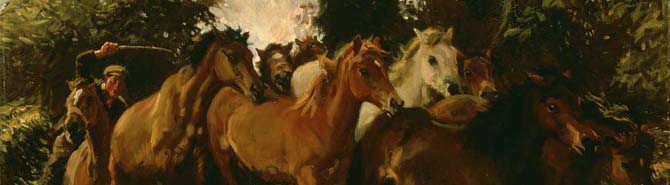
Coming through the Gap, 1910
Oil on canvas
Estimate: £1,200,000-1,800,000
|
 |
Munnings Country
By Lorian Peralta-Ramos
The Bunting Collection: one of the last great private collections of early Munnings pictures, from his career-making Norwich years.
Sir Alfred Munnings has been identified with the world of equestrian sport as strongly as Degas has to the world of the ballet dancer. Colorful images of horses breaking away at the start or majestically striding out with hounds have distinguished Munnings as one of the most astute sporting artists of all time. Most of these spectacular works were painted when Munnings had already achieved recognition from the Royal family and other wealthy horse owners, and he had been exhibiting at the Royal Academy for over 20 years.
Despite his association with the upper classes and their leisure pursuits, Munnings' true sympathies remained rooted in the country throughout his life. Some of his most perceptive and heartfelt renderings are the sensitive and appealing images of rural Edwardian England. The rich harvest of early paintings and watercolors in the Bunting sale are from one of the last existing large collections of early Munnings since the James C. Hardy sale in 1989. The 21 pictures were amassed during the first two decades of the 20th century by Mr Charles A. Bunting, like Hardy a prominent Norwich businessman and avid art collector. Munnings and Bunting were friends for years, and his pictures passed by descent to the present estate of his son Dr Charles F. Bunting.
The collection was seen publicly, as a group, in the 1928 retrospective exhibition at the Norwich Castle Museum. This attracted over 100,000 viewers, a record attendance in England since Rembrandt's 'Mill' had been on view in London in 1911.
The large finished version of Coming through the gap exemplifies Munnings's artistry. This masterpiece of equine observation shows a medley of anxious ponies cresting a hill, urged forward by the artist's most picturesque model, the gypsy boy called Shrimp. For over a decade, Munnings explored this theme of horses approaching the viewer, testing his technical acumen of anatomy, the visual mechanics of equine motion and his faultless sense of perspective. This was in direct response to seeing the renowned Colt Hunting in the New Forest (RA 1897) that earned Lucy Kemp-Welch national acclaim. Munnings says in his memoirs that he 'went out to beat it' by painting The Vagabonds (1902) three studies for which are in this sale.
This interest in movement also led Munnings to experiment with the aesthetic possibilities of the transitory reflections of sunlight. In Crossing the ford he deftly conveys the flickering light on swirling water as ponies traverse a river. Munnings painted a series of ford subjects simultaneously, changing canvases depending on the light of day. Here the light is subdued but the glimmer on the churning water is enlivened by the spontaneity of the vigorous brushwork.
Apart from its pictorial interest and charm, On the Ringland Hills epitomizes the artist's passion for the English idyll. The gypsy boy, a motif synonymous with a past and poetic existence, rides bareback with a simple halter and rope, unfettered by the complications of modern life. This freedom is echoed by the wide expanse of sky and the distant unenclosed landscape below the ridge. The ponies calmly trot forward, moving against the strong breeze that ruffles their manes and sends the clouds scudding overhead, removing the last trace of sunlight and issuing a warning of changing times ahead.
Munnings gave up watercolor painting in the late 1920s, but he was as masterful in this medium as he was in oils as seen in The White Slave. Here, Munnings articulates the form, volume, action and gesture of his subject with total assurance and a loving delicacy. His understanding and compassion towards horses is manifested in the portrayal of the countenance of the white pony, whose fate is uncertain, as he is roughly led away to be sold. The Bunting collection represents a fine offering of pictures generated while Munnings lived near Norwich, unencumbered by his later prestigious patrons' demands. The pictures were all created from his heart and reflect the kind of work that ultimately earned Munnings his place of honor as a Royal Academician and his national prominence.
Lorian Peralta-Ramos is the author of the forthcoming catalogue raisonné of the works of Sir Alfred Munnings
Back to top
|