 |
        |

|
       |

|
||
Sale 6460, Lot 17
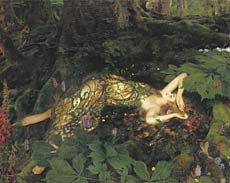
Frank Cadogan Cowper, R.A. (1877-1958) Titania sleeps, A Midsummer Night's Dream Oil on canvas Estimate:£120,000-180,000 |
Fantastic By Martin Beisly Imagination runs quite unashamedly riot in these fantastical works by Victorian painters. This sale includes some fine examples of works by Victorian artists in their familiar role of unashamed fantasists. The artists' readiness to let their imaginations run riot - whether the results are profound poetic insights or fairytale whimsicalities - never ceases to astonish and fascinate. Like Alain-Fournier's 'lost domain', their work is tantalizingly elusive. We yearn for its romance and its certainties even though we know that times have changed and there is a sense in which they are irrevocably beyond our reach. The Prince entering the Briar Wood by Burne-Jones is a version of one of the famous 'Briar Rose' series based on Sleeping Beauty. Having conceived the designs in the early 1860s for sets of tiles manufactured by the Morris firm, Burne-Jones re-cast them pictorially three times during the next 30 years. First came three small canvases showing the prince entering the briar wood, the king and his courtiers asleep, and the princess awaiting the awakening kiss. Now in the museum at Ponce, Puerto Rico, these pictures were executed in 1871-3 for William Graham, the wealthy MP for Glasgow who was Burne-Jones's greatest patron. Burne-Jones immediately embarked on the definitive large series, adding a fourth subject of servant girls who have fallen asleep at a loom or as they draw water from a well. Exhibited at Agnew's in 1890, these paintings attracted enormous crowds, effectively marking the climax of Burne-Jones's career. They were bought by the financier Alexander Henderson, later first Viscount Faringdon, and installed in the saloon at Buscot Park, Oxfordshire, where they remain to this day. The third set owes its existence to three of the Buscot paintings being recommenced during their long development, for reasons which are still not entirely clear. Burne-Jones completed the discarded canvases during his last years. Sold separately, they are now in three different public collections. Our picture belongs to none of these series. Apparently painted in 1869, it is considerably larger than the versions in Puerto Rico, and shows that Burne-Jones was already considering painting the subjects on a major scale before these pictures were executed. The figures of the prince and the sleeping knights are unfinished, but the briar-wood background is highly developed, giving the canvas a richly decorative and tapestry-like effect. J.M. Strudwick's The Wise and Foolish Virgins is also decorative in concept, the surface being worked with a jeweler's feeling for elaborately wrought detail. Early in his career Strudwick had been one of Burne-Jones's numerous assistants, and his paintings, though always recognizable, never cease to betray his master's influence. Indeed this example can be related to a pen-and-ink drawing of the same subject Burne-Jones had made in 1860 (private collection). Strudwick's picture was exhibited in 1884 at the Grosvenor Gallery, the temple of Aestheticism that had opened in Bond Street in 1877. Burne-Jones was the gallery's undisputed star, and all his followers showed there until they decamped with him to the New Gallery in 1888. Edmund Blair Leighton's The Accolade was exhibited at the Royal Academy in 1901, the year Queen Victoria died. The artist specialized in historical genre scenes, ranging from the early middle ages to the Regency era, and this is arguably his paintings of 'Victorians in togas', Blair Leighton's pictures are often modern subjects thinly disguised in the trappings of the past. The Accolade belongs to a group of works which, while ostensibly illustrating Arthurian chivalry as popularized by Tennyson, refer at a deeper level to the Boer War. By then historical and literary subjects were rapidly going out of fashion but they still had their uses when, as here, artists felt the need to distance reality and provide space for self-delusion. Some artists continued to paint literary themes long into the post-Victorian age. Frank Cadogan Cowper is one of the most remarkable examples, painting such subjects right up to his death at 81 in 1958. Mariana in the South takes its subject from a poem by Tennyson that had been illustrated by Rossetti and J.W. Waterhouse. It borrows a number of motifs from Van Eyck's Arnolfini marriage portrait in the National Gallery, a picture enormously admired by the Pre-Raphaelites. Titania Sleeps was exhibited at the Royal Academy in 1928 and looks back to the fairy painting so popular at the beginning of Victoria's reign. But it is fairy painting seen through the eyes of Hollywood at its most glamorous. Artists do not escape their period as easily as they think. Martin Beisly is Head of the Victorian Pictures Department. mbeisly@christies.com Tel: 44(0)20 7389 2468 |
|||||
|
 |
|||||
|
|
|
|
|
|
|
