


|
|
| |
| |
 | ||||||||
 |
|
 | ||||||
 | ||||||||
 | ||
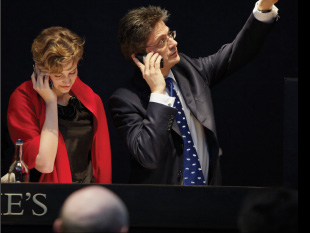 |
Christie’s Russian Art sales have led the last two important London seasons, as an already strong market becomes increasingly discerning. On 6 June, we established the highest price ever achieved for a 19th century Russian painting – Ilya Repin’s magnificent A Parisian Café, set a new world auction record for the artist at over £4.5 million, the top price for any lot sold during Russian Art Week across the auction houses. The appetite of the market could also be seen with the sale of The monk, the third work by Boris Grigoriev to be sold by Christie’s in the last year for over £500,000; while the impressive Kostakis collection of Nonconformist art was almost 100% sold. Dominating the Fabergé market in London for the past two years and continuing to hold market share, Christie’s also provided the Fabergé highlights of the June season. We sold eight Fabergé lots for over £100,000, as well as the top Fabergé lot of the week sold for £385, 250. The Christie’s London sale of Russian Art will be held on 28 November 2011. |
|
 | ||
 | ||||
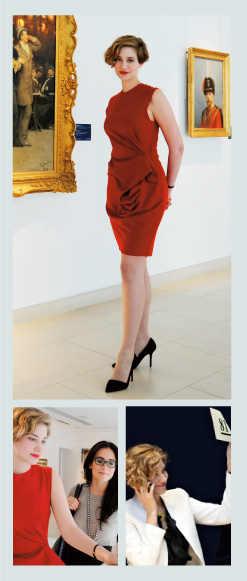 |
Q. What’s happening in the market for Russian art? A. That’s a big question, but I have to start with Ilya Repin’s A Parisian Café – it has definitely been a highpoint of my career so far, and such a privilege to work with. It was a painting that had been on our radar for many years; Alexis [Tiesenhausen, International Head of Department, Russian Art] had known the collector for a long time. We were so excited when it was consigned for sale – not only is it a very important picture for Repin, but its sale showed just how much appeal Russian art has today and has proved to be a significant landmark in the development of the Russian Art market. The June auction was such a great sale and it gave us a lot of publicity – the strength of our selling rates went out far and wide, so immediately afterwards I was on a plane to meet new clients wanting to consign. I haven’t had a day off since then. The November sale is equally exciting – but more on that soon! Q. How has the Russian art community developed? A. There’s so much going on, and the awareness of Russian art continues to increase. There have been so many extraordinary exhibitions worldwide since I started in 2004; I’m looking forward to the opening of the Soviet Art & Architecture exhibition at the Royal Academy, London, in October. Today, Russian art is much more widely recognised as a collecting field. Additionally, we’re looking at the exciting new areas of Russian Contemporary and Nonconformist art. These new categories bring in new strata of buyers. It’s an investment area: you can get great pieces for £40,000-50,000, or works on paper by significant artists, say, Kabakov or Zverev, for under £10,000. Q. Why do you think it’s undergoing such a strong resurgence? A. Alongside the high-profile exhibitions, I think the reassessment is due to a greater understanding of the |
|
close ties between Russian and other European artists. The unfounded reputation of Russian art as provincial has entirely collapsed. Many of the artists considered as ‘Russian’, Baranoff-Rossinè for example, actually worked in Paris alongside the great European artists of the period. As another example: how many people know that, arguably, the best collection of Matisse was a Russian one – Sergei Shchukin’s. He supported Matisse when few others would, and opened his collection to Russian artists – encouraging their exposure to the very best of European art. This in turn was a major inspiration to the Russian Avant Garde movement.
Q: What brought you into Russian art? A: I’d studied Russian at school, and then English Literature and Russian at Oxford. I’d always loved art, but I wanted practical exposure, so after working in the City for a short period, I got an internship at Christie’s in 2004. I started in the Drawings & Watercolours department, and moved to Russian Art later that year. Cataloguing paintings and works on paper first-hand is the best way to learn the field and develop your ‘eye’. I never forget how privileged we are to be able to sit with works of art. We get to see them unframed, in such proximity, in a way that you couldn’t do anywhere else. Q: Is your job only about art? A: No! There’s the client side, something I really cherish – I’ve met some incredible people and heard some fascinating stories! Then there are the occasions when we have changed people’s lives: when we have discovered unrecognised works in a family collection and then sold them for their true value – few things can compare to seeing the look on a client’s face when their work exceeds the high estimate! As awareness of Russian art grows, people have been looking again at the pictures on their walls. A hard-to-read signature could be in Cyrillic – with our help it can be identified: maybe it’s an important painting! |
|
 | ||||
 | ||||||
|
Boris Grigoriev (1886-1939) The monk, 1922 31½ x 25¼ in. (80 x 64.1 cm.) Estimate £300,000–500,000 Sold for £713,250 |
Oleg Tselkov (b. 1934) Mask and dragonfly, 1976 25¼ x 21¼ in. (64.5 x 54.5 cm.) Estimate £15,000–20,000 Sold for £39,650 |
A Jewelled Two-Colour Gold-Mounted and Guilloché Enamel Table Compass Marked Fabergé, with the workmaster's mark of Michael Perchin, St Petersburg, 1899-1903, Scratched Inventory Number 4366 Estimate £80,000–120,000 Sold for £205,250 |
|
A Rare and Important Three-Colour Gold and Guilloché Enamel Imperial Presentation Snuff-Box Marked Fabergé, with the workmaster's mark of Michael Perchin, St Petersburg, circa 1890, Scratched Inventory Number 999 Estimate £300,000–500,000 Sold for £385,250 |
|
 | ||||||||
 |
|
| ||||||
 | ||
 |
Interested in providing feedback or suggestions for future issues of the Russian Art Newsletter? New York +1 212 636 2260 UK: + 44 (0) 20 7389 2057 Paris: +33 1 4076 8403 Email: kmerkalenko@christies.com |
 |
 | ||
|
 |



