|
Norman Granz is remembered around the globe as a champion of Jazz, but art historians also remember him as one of the world's foremost collectors of Modern Art. He was most famous for his Jazz at the Philharmonic concerts, which brought Jazz to the greater public and changed America's attitude to race relations - black and white performers shared the stage, and a mixed audience enjoyed their music. As Mr. Granz himself recalled, 'the whole reason for the JATP, basically, was to take it to places where I could break it down, break down segregation and discrimination, present good jazz and be successful for myself and for the musicians.'
Among countless others, he influenced the careers of Billie Holiday, Dizzie Gillespie, Charlie Parker and Ella Fitzgerald. His professional relationships were characterized by mutual respect, admiration and, most of all, friendship. Even if it meant having to cancel concerts, with huge financial losses, and even being threatened with jail, protecting his artists and their integrity was his priority.
He applied this principle to his other passion - collecting modern art. Masterpieces by Picasso, Léger and Gris, was assembled with relentless energy, without hesitation or second thoughts. A masterly survey of the course of modern art, it will be remembered, like its creator, with the highest admiration.
Through their passion for art, Mr. and Mrs. Granz became close friends of Picasso, whom they first met in 1968. They often enjoyed his company once or twice a week and Mrs. Granz recalled heated ping-pong matches: 'My husband was a pretty good ping-pong player, he was left-handed so he had an edge, but Picasso was not bad either…' Picasso dedicated countless drawings to his close friend, and in 1973 Granz named a record label he founded Pablo Records.
The evening sale at Rockefeller Centre on 6 November includes two works from the Granz Collection that bracket the great modernist movement in 20th-century European art: Picasso's La Guenon et son petit, 1951, and Léger's Les deux acrobates, 1918.
The Léger is his most important painting to appear at auction since Christie's sold Le moteur from the Gaffé Collection last November for $16,726,000. Les deux acrobates was painted the same year as Le moteur, while he was convalescing from illnesses contracted in the trenches. It is one of a series of seven paintings which feature the celebrated Cirque Médrano in Paris, previously painted by Degas, Renoir, Seurat, Lautrec and Picasso.
While Le moteur and related works elevated the machine as a proper subject for modernist painting, in Les deux acrobates Léger depicts man at play, as a relief from the privations of war and a return to the pleasures of pre-war Paris. It also looks forward to a new conception in which the mechanical aspect of modern life is viewed not as a negation of man, but as a constructive and dynamic element essential to man.
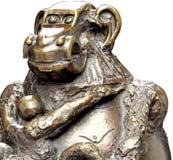
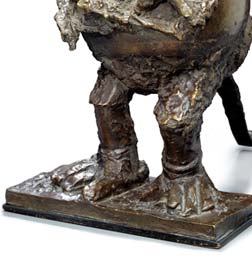
Picasso's La Guenon et son petit uses another modernist innovation, the art of assemblage he developed from his cubist papiers collés and introduced in his 1914 sculpture Le verre d'Absinthe. He manipulated real or found objects to create visual metaphors and extended the parameters of art. La Guenon et son petit is the crowning achievement of the series of assemblage sculptures Picasso made during 1950-1951 in the studio of 'La Galloise' in Vallauris, where he lived with Françoise Gilot and their children, Claude and Paloma. Picasso has taken two model cars the dealer Kahnweiler gave to Claude to make the baboon's head. The body is made from a large pot, to which Picasso affixed handles from other pots, plus pieces of wood and metal, all joined and finished with plaster.
Norman Granz realized the importance of this sculpture and it soon joined the other Picassos in his collection. Mrs. Granz recalled how La Guenon et son petit stood in the living room of their London residence: 'It is a fascinating sculpture, challenging and at the same time very moving. It quickly became our house mascot; every day I patted the baboon on the head for good luck. The sculpture's presence dominated our entire living room, and unavoidably became the conversation piece with our guests and friends.' The Granz sculpture is the fourth of six examples that Picasso had cast in bronze, and is one of the last remaining in private hands.
THOMAS SEYDOUX IS THE DIRECTOR OF THE IMPRESSIONIST AND MODERN ART DEPARTMENT AT CHRISTIE'S PARIS AND GENEVA
Back to top
|
 |
|
Sale 1147, lot 42
Pablo Picasso (1881-1973)
La guenon et son petit
Bronze with brown patina
Estimate : $5,000,000 - 7,000,000
|
|